
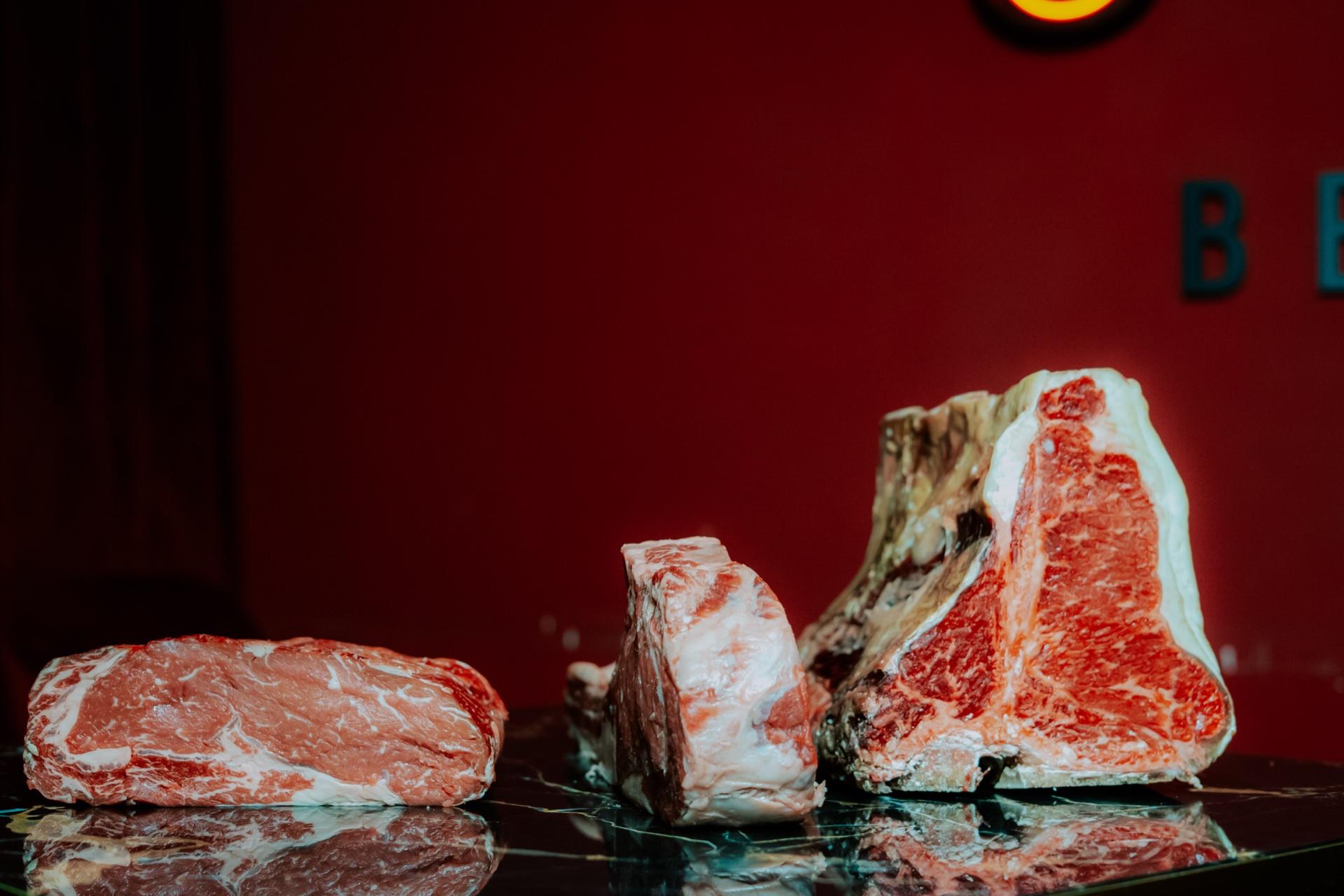
Chateaubriand is a thick cut taken from the widest part of the beef fillet, cooked whole and usually served for two people, often with a béarnaise sauce. It is named after a nineteenth-century French writer, François-René de Chateaubriand. At Carpaccio Beef Restaurant, at Via Marche 9, it is on the grill, in the boneless selection: you order it for at least two people and it comes with the Carpaccio Sauce, our béarnaise with mustard and parsley.
What chateaubriand is
The thick end of the fillet
The fillet is the muscle that runs under the spine of the animal. It does almost no work, which makes it the most tender cut: almost no connective tissue, little marbling and a delicate taste. It is long, with a narrow end and a thicker part.
Chateaubriand comes from the wide part. The filet mignon, by contrast, comes from the narrow tip. Same meat, same tenderness, but different sizes and cooking: the mignon is a small single portion, while chateaubriand is a thick piece that cooks whole and is then divided.
One piece, two people
The thick part of the fillet yields enough meat for two, and that is how the dish has traditionally been served. So in restaurants chateaubriand is almost always ordered by a pair: it is the fillet to share, as the T-bone and the tomahawk are the bone-in cuts to share. How it differs from the other cuts on the grill is in our guide to the differences between cuts.
Chateaubriand or tagliata?
They are served in a similar way but start from different cuts. Tagliata is a way of serving meat: a whole piece grilled, left to rest and sliced across the grain, usually strip loin. Chateaubriand is always fillet, with more tenderness than a tagliata and less of the taste of fat. If someone at the table wants softness, it is the right choice.
Where the name comes from
The name is that of François-René de Chateaubriand, a French writer and aristocrat. There are two versions of how the dish was born. The more quoted says it was created by his personal cook, in his honour, in the early years of the nineteenth century. Another credits a cook at the Paris restaurant Champeaux, active later in the same century. In both versions chateaubriand remains a Parisian dish.
The béarnaise
The classic sauce for chateaubriand is béarnaise. The Treccani dictionary describes it as a sauce of beaten egg yolks and butter, with shallot or leeks, vinegar, tarragon, parsley, salt and pepper, cooked in a bain-marie. The name comes from the Béarn, a region of south-western France at the foot of the Pyrenees.
On a fillet, which has little fat, béarnaise adds butter and yolks, while the vinegar and herbs keep it fresh. As an alternative to béarnaise, tradition also uses a sauce of shallot and wine.
Chateaubriand at Carpaccio Beef Restaurant
On the grill, for at least two
Until the start of summer our Chateaubriand was in the Comfort Zone section of the menu. With the new menu it moved to the grill, to the boneless selection from around the world, next to ribeye, fillet and sirloin steak. You order it for at least two people, as tradition has it, and it cooks on our ceramic slabs, which reach 900 °C.
A thick piece of fillet over that much heat does two things: a thin crust forms outside in moments, and the inside stays soft and pink. We recommend it rare or medium. Beyond medium the fillet, which has little fat, dries out and loses the very softness you order it for. After the grill the meat rests for a few minutes so the juices redistribute.
The Carpaccio Sauce
Chateaubriand comes with the Carpaccio Sauce, which our menu describes as a béarnaise with mustard and parsley. It is our version of the classic sauce: the base of yolks and butter stays, and the mustard adds a sharp note that goes well with the crust from the grill. The same sauce can be ordered on the side with the other cuts, and next to it is the Malagueta Sauce, made with grains of paradise, for anyone who prefers a more peppery sauce.
Allergens and sides
With its sauce, the Chateaubriand contains eggs, milk, mustard, soy and sulphites, as the full menu with allergens shows. If you have allergies, the kitchen confirms the ingredients dish by dish.
Britannica notes that chateaubriand is usually served with roast potatoes and asparagus. With us the sides come in small pans, ordered separately: the potato rösti or the mashed potatoes go well with the béarnaise, the spinach or chicory lighten it.
What to drink with chateaubriand
The fillet is delicate and the béarnaise is rich. You need a medium-bodied red, with fruit and acidity, that does not cover the meat: a Pinot Noir, a Nebbiolo Langhe, a Chianti Classico. A very tannic red next to such a lean cut seems hard. You will find the pairings cut by cut in our article on wine with grilled meat.
If dinner begins with a pasta, a carbonara or an amatriciana to share before the Chateaubriand is a Roman sequence that works even for two. If you would rather have a large bone-in piece, the grill has T-bone, costata and tomahawk, and our article on Black Angus has the questions to ask before ordering them.
Book at Carpaccio Beef Restaurant
We are at Via Marche 9, on the corner of Via Sicilia, a short walk from Via Veneto. Dinner is every day from 7:00 pm, until 10:30 pm Sunday to Thursday and until 11:00 pm on Friday and Saturday; lunch is Monday to Friday, 12:30 pm to 3:00 pm. The full list of dishes is on the menu. Book with the "Prenota" button on the website, on TheFork or at +39 06 86218298.