
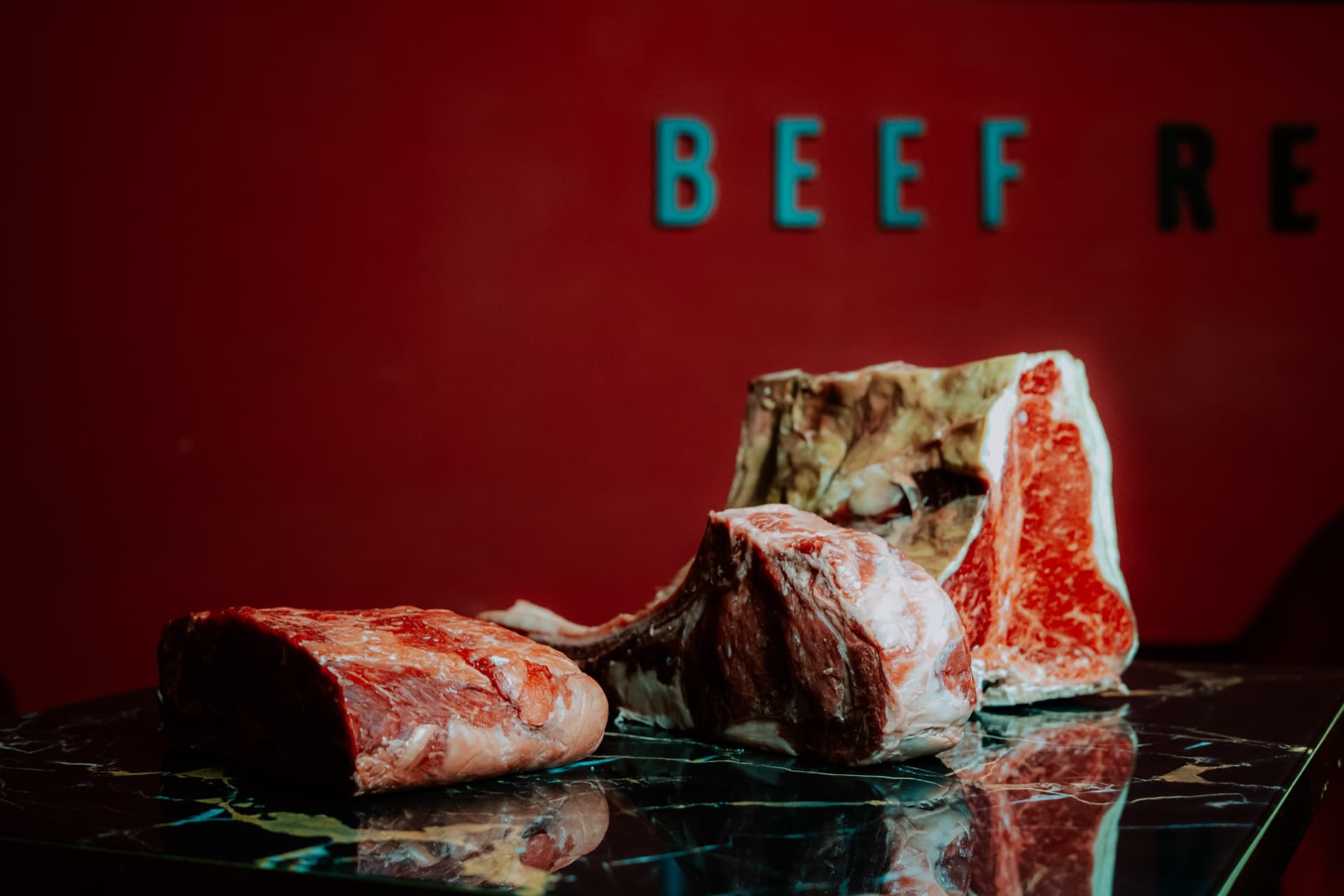
Black Angus is the name used for the meat of Aberdeen-Angus cattle, a breed that began in the north-east of Scotland in the early nineteenth century: black, hornless animals, now raised in many countries. The meat has good but not extreme marbling and a full beef flavour, and it suits large cuts on the grill. At Carpaccio Beef Restaurant, at Via Marche 9, it is, together with Wagyu, the base of the grill and of the raw dishes.
What Black Angus is
A Scottish breed
The history is told by the Aberdeen-Angus Cattle Society, the breeders' association. In the north-east of Scotland there had been black, hornless cattle for centuries, which in dialect were called "doddies" and "hummlies". In 1808 Hugh Watson took the lease of the farm at Keillor, in the county of Angus, and began to select them. In 1824 William McCombie did the same at Tillyfour, in Aberdeenshire, starting largely from Watson's lines, and took his animals to shows in England and France. The breed takes its name from these two counties.
The breed register, the Herd Book, was founded in 1862 and the Society in 1879. From there the breed left Scotland and reached the herds of the big beef-producing countries. "Black" refers to the coat, the most recognizable trait.
A breed name, not a cut
Black Angus tells you which animal the meat comes from, not which part of the animal you are eating. A costata (bone-in ribeye), a fillet or a T-bone can be Black Angus like any other breed. The name alone does not tell you where the animal was raised or how long the meat was aged: those are questions to ask separately.
What kind of meat it is: marbling and flavour
As with Wagyu, the thing to look at is intramuscular fat, the marbling: fine veins inside the fibre that melt during cooking and keep the meat juicy. Angus has a good amount, far less extreme than Japanese Wagyu. The result is a meat that tastes of beef in a direct way, with enough fat to stand up to a long time on the grill.
That is why Black Angus does well in the big cuts: a T-bone, a costata or a tomahawk must stay on the heat long enough to form a crust without drying out, and the fat of Angus allows it. Wagyu works at the opposite extreme, with small portions and short cooking; we describe the difference between the two meats in our article on Wagyu.
How to choose Black Angus in a restaurant
The word Angus appears often on menus, and on its own it says little. Three questions help you understand what will arrive on the plate.
The first is about origin: which country the meat comes from and what kind of farm. The same Angus changes a lot depending on where and how the animal grew up. The second is about the cut and the weight: bone-in or boneless, how many grams, whether it is shared. The third is about ageing, meaning how long the meat rested before reaching the kitchen.
These are ordinary questions, and you can ask them in any meat restaurant before ordering a serious cut.
Black Angus at Carpaccio Beef Restaurant
On the grill
Our grill is divided by selection. The bone-in selection from around the world includes T-bone, costata and tomahawk; the boneless one has ribeye, fillet and sirloin steak; then there is the Selezione Wagyu Japan. The meat on the grill is Wagyu and Black Angus. We cook on ceramic slabs that reach 900 °C: the meat stays on the heat for a few moments, a thin crust forms outside and the juice stays inside.
For the big bone-in cuts, meant for sharing, and for how many grams to order per person, there is our guide to the differences between cuts. Ask in the dining room where the meat of the evening comes from, together with the doneness.
With two people, if you want to taste the difference between the two meats, you can order a boneless cut from the selection from around the world and one from the Selezione Wagyu Japan, and share them. The first shows what the grill does to a full-flavoured beef, the second what happens when the fat almost completely melts.
Raw
Black Angus is not only for the grill. In the carpaccios and tartares we use the same selections, Wagyu and Black Angus, cut very thin or cut by hand with a knife and dressed at the moment of serving. Raw, the moderate marbling of Angus is an advantage: it gives flavour without weighing the dish down. We usually start with the Cipriani, with burrata cream, Parmesan shavings and lemon dressing; the other options are in our guide to the carpaccios.
Doneness and wine
With Black Angus we suggest rare or medium. The fat has to melt without burning, and beyond medium the meat loses juice and the differences between cuts flatten out. After the grill it needs a few minutes of rest so the juices redistribute.
For wine, a costata of Black Angus wants a red with tannin and acidity, such as a Barolo or a Taurasi; a fillet sits better with a lighter red. The pairing cut by cut is in our article on wine with grilled meat.
Book at Carpaccio Beef Restaurant
We are at Via Marche 9, on the corner of Via Sicilia, a short walk from Via Veneto. Lunch is Monday to Friday, 12:30 pm to 3:00 pm; dinner is every day from 7:00 pm, until 11:00 pm on Friday and Saturday. The full list of dishes is on the menu. Book with the "Prenota" button on the website, on TheFork or at +39 06 86218298.