
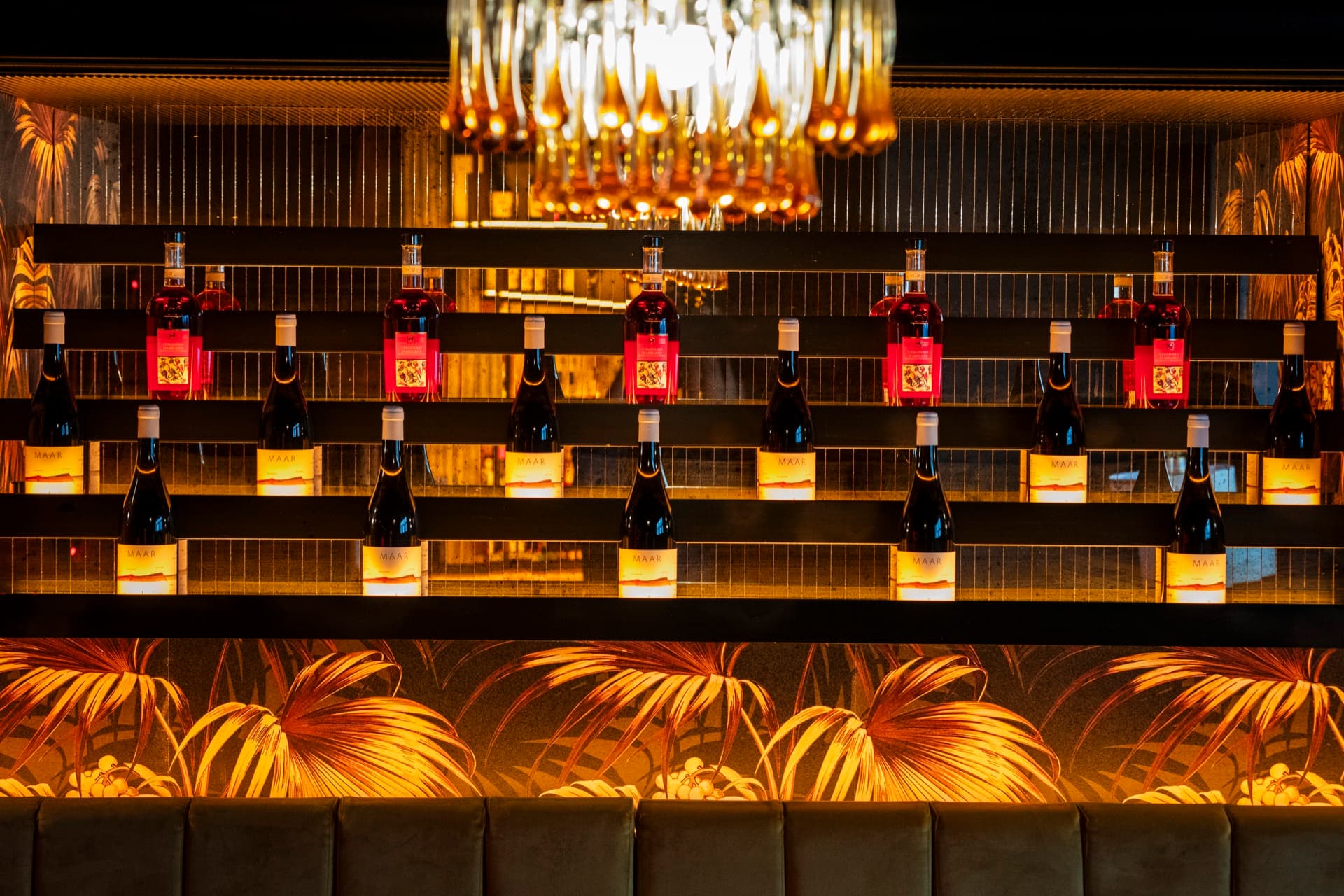
With grilled meat, the right wine depends on the cut. A costata (bone-in ribeye) or a ribeye, rich in fat, wants a red with tannin and acidity, such as a Barolo or a Taurasi. A fillet, lean and delicate, sits better with a lighter red, for example a Pinot Noir. In summer a structured rosé or a red served cooler than usual will stand up to the grill without weighing you down. Our wine list runs past a hundred labels and is built for exactly this job.
Wine and grilled meat: fat, tannin, acidity
A grilled cut puts two things in your mouth: the crust, which forms in moments on our ceramic slabs at up to 900 °C, and the fat melting inside the fibre. The wine has to make room for both.
Tannin, the dry feeling reds leave on your gums, finds support in the fat and protein of the meat and softens. Acidity cleans the mouth between bites. That is why the fattier cuts can carry the more structured reds, while on a lean cut the same wine seems hard. The opposite also holds: a wine that is too light, next to a costata, disappears after the first sip.
Which wine with which cut
What follows is a starting point. The cuts are the ones on our grill, described one by one in our article on the differences between cuts.
Costata, ribeye and tomahawk
These are the most marbled cuts: the fat melts as they cook and keeps the meat juicy even when the surface is already caramelised. Here the list does its best work with Piedmont and the South. From the Langhe come the Barolo Castelletto from Castello di Perno and the Barbaresco from Bruno Rocca; from Campania, the Taurasi of Mastroberardino, Feudi di San Gregorio and Di Meo; from Umbria, the Montefalco Sagrantino from Perticaia, the most tannic of the group. With a tomahawk to share among three or four people, one of these bottles is enough for the whole meat course.
Fillet and lean cuts
The fillet has very little fat and a delicate taste. A very tannic red covers it and makes it seem dry. A medium-bodied wine with fruit and acidity is better: the Pinot Nero from Elena Walch in Alto Adige, or the one from Frescobaldi at Pomino in Tuscany; for Burgundy, the Pinot Noir "Sous la Murée" from Domaine Arnoux. The Nebbiolo Langhe from Castello di Perno also works well, with the character of a Barolo and a gentler tannin.
T-bone, two cuts in one
The T-bone holds together the strip and the fillet, a more flavourful side and a more delicate one. You need a red that sits in the middle. Tuscany is the natural choice: a Chianti Classico such as the Tenuta Perano from Frescobaldi, a Rosso di Montalcino or, if the evening asks for it, a Brunello di Montalcino. From Bolgheri there are also the Sassicaia and the wines of Poggio al Tesoro and Fittipaldi.
Wagyu
The Selezione Wagyu Japan is very highly marbled and comes in small portions. With a very powerful red the risk is adding richness to richness. Aim for acidity instead: a Barbera d'Alba Superiore such as the "Marun" from Correggia, an Etna Rosso such as the "Ghiaia Nera" from Tenuta Tascante, or a sparkling wine, which does the same job with Wagyu fat as it does with the carpaccios. How to recognise real Wagyu is covered in our article on Wagyu.
In summer: structured rosé and cooler reds
In August in Rome, an Amarone at the temperature of a warm room is hard work even for people who love it. There are two ways to keep wine with the meat.
The first is structured rosé, with enough body for grilled meat. The Cerasuolo d'Abruzzo from Tenuta Ulisse is the closest to a red; the Lagrein Rosé from Tramin comes from Alto Adige; the Etna Rosato "Sul Vulcano" from Donnafugata and the "Madamarosé" from Sallier de la Tour come from Sicily, and "Le Papesse" from Argentaia from Tuscany.
The second is reds that can take a few degrees less: the Dolcetto d'Alba from Castello di Perno, the Cerasuolo di Vittoria "Floramundi" from Donnafugata, and the Pinot Noirs already mentioned. Served cooler than usual they stay juicy and are easy to drink even at the end of lunch. If you come for lunch in summer with a boneless cut, this is the simplest choice.
And with the carpaccios?
A table that starts with raw dishes and ends with the grill often changes wine halfway through. With carpaccios and tartares, tannic reds are best avoided: on raw meat, with no crust and no melted fat, they leave a dry, bitter note. Sparkling wines are better, from the Franciacorta of Bellavista and Contadi Castaldi to the Champagnes, or a white with lively acidity. The same goes for the Dolce Vita, the carpaccio with tonnato sauce.
With carbonara and amatriciana we stay in Lazio, with the Cesanese: the "Amantes" from Mergè and the "Tefra" from Campolavico.
How to choose in the dining room
With four people, the easiest solution is often a bottle of sparkling wine for the raw dishes and a bottle of red for the meat. With two, you can ask for a glass for each stage: the dining room will tell you what is open by the glass that day. Say which cuts you have ordered and how much you want to spend, and the suggestion starts from what is on your plate. The list runs from Champagne to Sicily and covers fifteen Italian regions, so for each cut there is more than one way to go.
Book at Carpaccio Beef Restaurant
We are at Via Marche 9, on the corner of Via Sicilia, a short walk from Via Veneto. Lunch is Monday to Friday, 12:30 pm to 3:00 pm; dinner is every day from 7:00 pm, until 10:30 pm Sunday to Thursday and until 11:00 pm on Friday and Saturday. Book with the "Prenota" button on the website, on TheFork or at +39 06 86218298.