
You will find carbonara near Via Veneto at Carpaccio Beef Restaurant, at Via Marche 9, next to the amatriciana: they are the two Roman first courses on our menu, made with pasta from the Verrigni pasta factory. We are a meat restaurant, but the pasta page is as much a part of dinner as the grill. Here we describe how the two recipes are made in the Roman tradition, what you will find on our menu and what to drink.
Why a meat restaurant has carbonara
On the menu we put it this way: many people come for the meat, but they find a wider kitchen, built also around the flavours of Roman tradition. The pasta arrives between the raw dishes and the grill, as in a Roman lunch, or on its own at lunchtime when you are short of time.
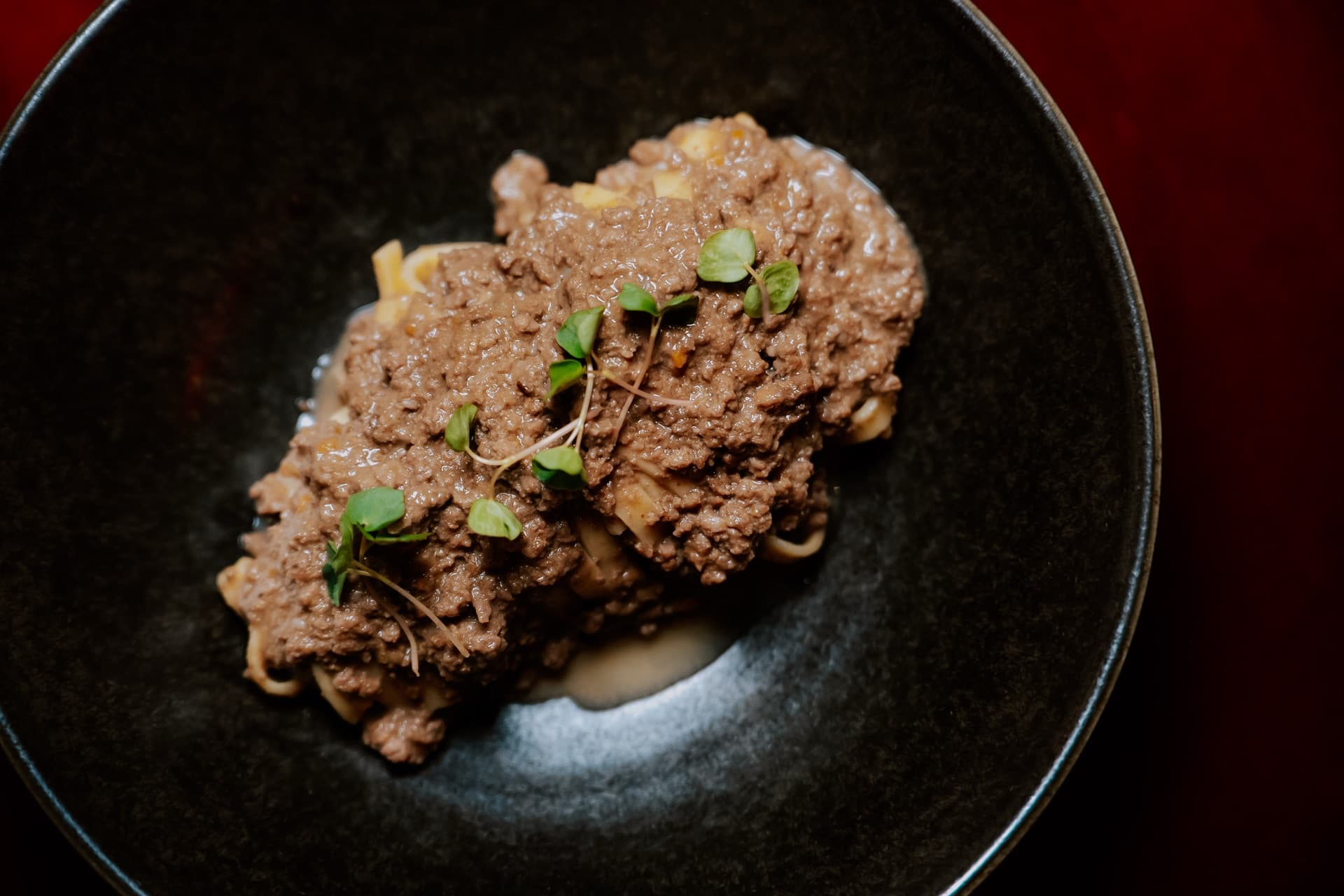
On the same page of the menu there are three other first courses: tagliolini with truffle, tagliolini with three tomatoes and fresh egg fettuccine with A5 Wagyu ragù. Carbonara and amatriciana are the two that come from Roman tradition.
Carbonara in the Roman tradition
The ingredients
Turismo Roma, the city's tourism portal, sums up the traditional recipe in six ingredients: durum wheat semolina pasta, guanciale (cured pork cheek), pecorino romano, eggs with more yolks than whites, salt and freshly ground pepper. There is no cream, and the portal says so with an exclamation mark. There is no pancetta, garlic or onion either.
The method is easy to describe and hard to do well. The guanciale is cut into strips and rendered slowly. The eggs are beaten with the pecorino and a pinch of salt. The pasta, drained al dente, goes into the pan with the guanciale; then, off the heat, the eggs and plenty of pepper go in, and everything is stirred quickly. The eggs have to turn into a cream from the heat of the pasta alone: one moment too long on the flame and they become an omelette.
Where it comes from
There is no agreement on the origin. One theory links it to an older dish of cheese and eggs, made by charcoal burners in the Apennine woods. Another takes it to 1944, when American soldiers in Rome are said to have eaten a pasta made with ingredients that recalled their breakfast, eggs and bacon. Neither is proven, and the recipe remains one of the most representative of the city.
Amatriciana and gricia
Amatriciana comes from a pasta with no tomato, gricia, which according to Turismo Roma was born in a small mountain village between Lazio and Abruzzo, where shepherds carried ingredients that keep: guanciale and pecorino. The tomato came later. The first to document its use in cooking, the portal writes, was Francesco Leonardi in his L'Apicio moderno of 1790.
Today's Roman recipe puts together guanciale, peeled tomato, grated pecorino romano and a little chilli, with bucatini as the classic shape. Since 2020 the sauce "Amatriciana tradizionale" is also a Traditional Specialty Guaranteed (TSG) of the European Union, with a specification that fixes guanciale, pecorino and tomato as the base ingredients.
What you will find at Carpaccio Beef Restaurant
Two Verrigni pasta shapes
On our menu the carbonara is made with spaghetti and the amatriciana with mezze maniche ("half sleeves", a short, wide tube), both from Verrigni. It is a pasta maker in Roseto degli Abruzzi, working since 1898, which produces pasta extruded through gold dies and through bronze dies, dried slowly at low temperature for up to 72 hours. The mezze maniche are a short, wide shape that holds the sauce inside the tube; spaghetti leave it to the cream of eggs and pecorino to coat the pasta.
Allergies and intolerances
In the full menu with allergens every dish has its codes next to it. For someone with an egg allergy the difference between the two pastas matters: the carbonara contains eggs, the amatriciana does not. Both contain gluten and dairy. If you have doubts, the kitchen confirms the ingredients dish by dish.
The Romano: Roman cooking on a carpaccio
If you want Rome in the raw course too, there is the Romano: a beef carpaccio with artichokes, crisp guanciale and crunchy bread. The guanciale is the same ingredient as in the carbonara and the amatriciana, here crisp on top of the raw slice. We described it together with the others in our piece on the house variations.
How to put dinner together
A sequence that works for two: a Romano to start, a carbonara or an amatriciana each, then a grilled cut to share, and chicory among the small pans of sides. If the evening is shorter, a carpaccio and a pasta are enough. At lunch, Monday to Friday, it is the quickest combination.
What to drink with carbonara and amatriciana
With Roman pasta we stay in Lazio. The wine list has two Cesanese, the "Amantes" from Mergè and the "Tefra" from Campolavico. Cesanese is a red from Lazio, and on our list we pair it with the Roman pastas: with guanciale and pecorino you need a wine that cleans the mouth, with the tomato of the amatriciana one that will not be overpowered.
If the grill comes after the pasta, choose the second wine with the cut in mind: our article on wine with grilled meat has the pairings.
Where we are, compared with Via Veneto
We are at Via Marche 9, on the corner of Via Sicilia, a street parallel to Via Veneto one block away. From the Barberini metro stop, line A, it is about ten minutes on foot, uphill; Porta Pinciana and Villa Borghese are a few minutes away. To find your way around the rest of the neighbourhood there is our area guide.
Book at Carpaccio Beef Restaurant
Dinner is every day from 7:00 pm, until 10:30 pm Sunday to Thursday and until 11:00 pm on Friday and Saturday. The average bill is around €50 a head, wine not included. Book with the "Prenota" button on the website, on TheFork or at +39 06 86218298.