
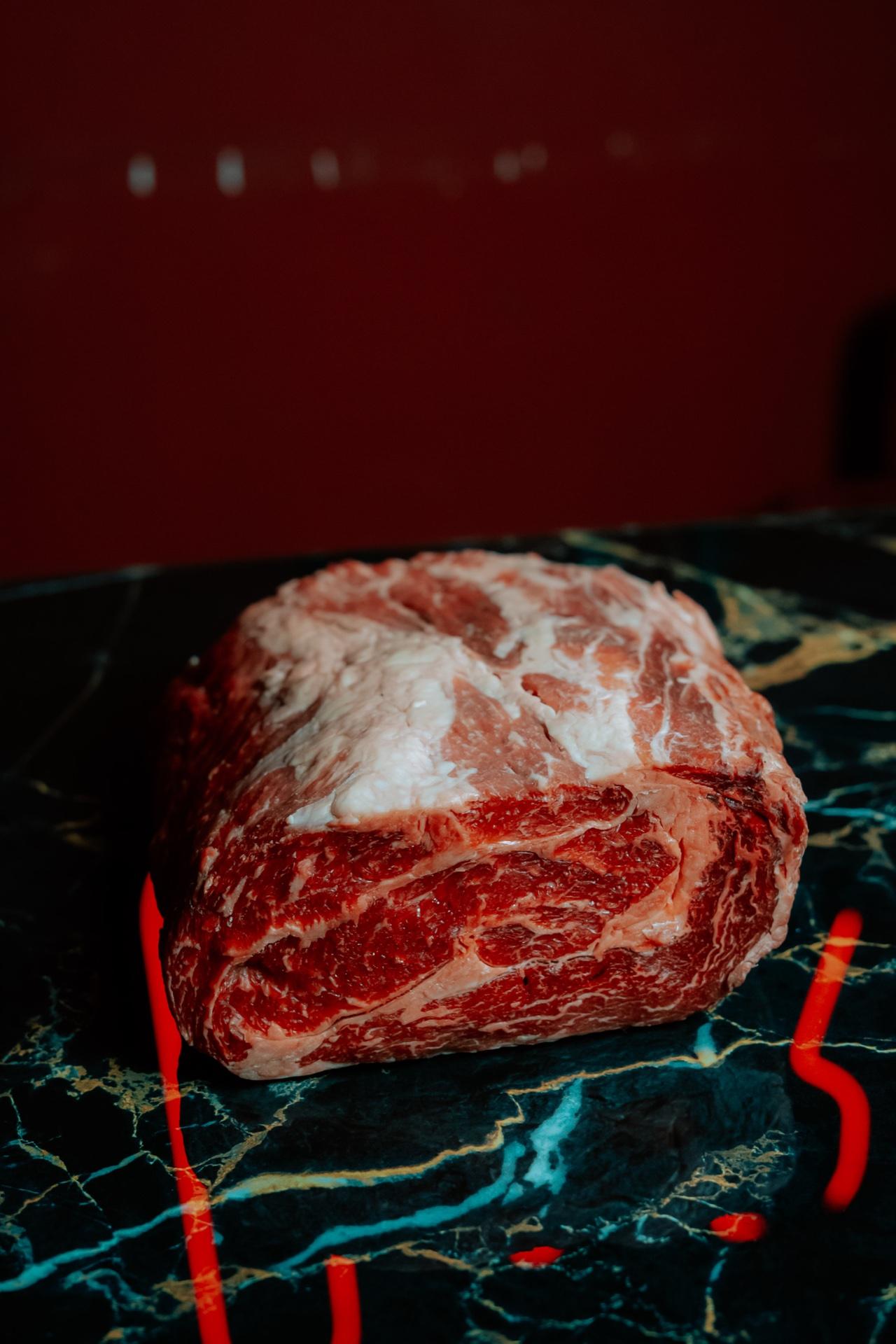
Vitello, vitellone, scottona and manzo are words you read on labels and menus in Italy, and they do not all mean the same thing. The first two describe the animal's age at slaughter: vitello is under eight months, vitellone is from eight to under twelve months. Scottona and manzo are names that can accompany the sales description and say what kind of animal it is. If these are new words to you, you are not alone: in shops and restaurants they are often used as synonyms, and they are not.
The age categories
Age at slaughter is the criterion used to classify beef in Italian and European labelling, governed by the European rules on beef labelling. Three categories matter to someone buying or ordering.
Vitello is an animal slaughtered before eight months. The meat is pale with a delicate flavour.
Vitellone is an animal between eight and twelve months. It is the category that in everyday language goes with steak cuts: darker meat, more flavour, still tender.
Animals that fall outside these two categories are labelled bovino adulto, adult bovine. All older animals belong here, and the meat is usually darker with a fuller flavour.
For vitello and vitellone the law asks for the animal's age at slaughter to be shown on the label, in addition to the name. So when you buy a piece of vitellone, you should be able to read the months.
What scottona is
Scottona is a young female, normally one that has not yet had calves. It is not an age category of its own, as vitello and vitellone are, but a name that can be added to the sales description to say what kind of animal it is. In everyday use scottona suggests tender, flavourful meat with a fine grain.
To see where it turns up: the best-known cut made from vitellone or scottona is bistecca alla fiorentina. The name gives the cut and the recipe, while vitellone and scottona say which animal it comes from.
What manzo is
"Manzo" is the most common word and the least precise. In labelling it is one of the names that can be added to the sales description, together with scottona and cut names such as filetto. In everyday language "manzo" means beef in general, and that leaves room for many misunderstandings. When you read "carpaccio di manzo" or "tartare di manzo" on a menu, the word tells you the meat is beef. It does not tell you the age, the breed or the cut. For those details you have to ask.
If you want to understand how the result changes with the cut, you need another piece of information: where the piece sits on the animal. We looked at it in the article on beef carpaccio, where a lean cut such as the strip loin works raw, and in the one on steak doneness, where thickness and bone matter more than minutes.
Breeds: a brief note
The age category says nothing about the breed. Two vitelloni of the same age may belong to different breeds, with different meat. Italy has beef breeds with a long history, and the best known is the Chianina.
The Chianina comes from the Val di Chiana, between Arezzo and Siena in Tuscany. It has a porcelain-white coat and is considered the largest of all cattle breeds. It is an ancient breed: traces of it appear already in Pliny the Elder. Chianina beef has its own mark, the PGI "Vitellone Bianco dell'Appennino Centrale", which guarantees controls and certification along the supply chain.
The Chianina is often named together with the Marchigiana and the Romagnola, two other breeds from central Italy. A 2015 study by the University of Tuscia concluded that the three breeds share common origins. That does not make them the same. It means they belong to one family, and people who know them tell them apart by the area where they are raised and by the character of the meat.
How to read a label
The information that counts is limited and almost always in the same place. On the label of a cut sold in Italy you find the sales description (for example "vitellone" or "bovino adulto"), with the age shown where it is compulsory. You also find the traceability system that follows the meat from farm to shop.
For the rest, optional descriptions and marks such as the PGI add information, but only when they follow the rules of their own specifications. A wording that sounds good, like "selection" or "quality", is not a legal category and should not be read as one.
What to ask at the table
When a meat is presented with a name that makes you curious, four questions are enough. Which animal it comes from: vitello, vitellone, scottona, bovino adulto. Which breed. Where it comes from. And how it is served, meaning which cut and which doneness.
The right answer is a precise one. People who know their trade name a breed and an origin without hedging, and say calmly when they do not know a detail, promising to check. You can also look at the menu before you come and prepare your questions.
Book at Carpaccio Beef Restaurant
We are at Via Marche 9, on the corner of Via Sicilia, a short walk from Via Veneto. Book with the "Prenota" button on the website, on TheFork, or by phone at +39 06 86218298.