
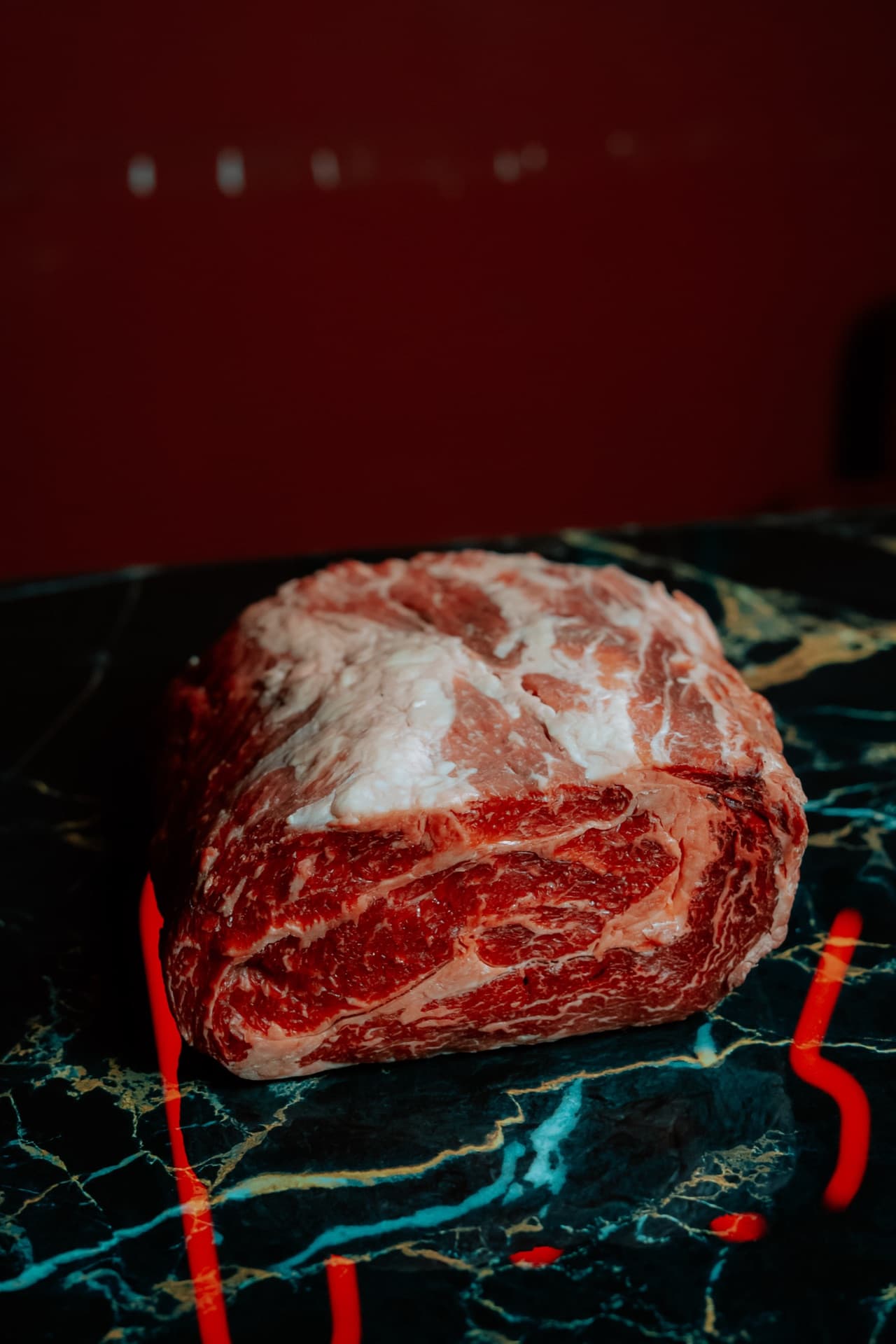
You choose how a steak is cooked by looking at the centre of the cut. Rare has a red centre that is only just warm, medium has a pink centre, and well done is grey and dry all the way through. None of the three is wrong. They change the texture and the flavour, and they change how well the cut you picked will hold up.
What the three look like
"Al sangue", the Italian for rare, means a red, tender, barely warm centre with a dark crust outside. The fibre stays soft and the cut gives off plenty of juice. For bistecca alla fiorentina, the Tuscan T-bone, tradition points to about 50-52 °C at the core, which is a useful reference for what rare means.
Medium has a pink centre, firmer, with less juice. Many people order it without thinking, because it sits halfway and keeps the whole table happy.
Well done has a grey-brown centre and drier fibre. It works with cuts that carry some internal fat, because the fat makes up for the lost juice. On a fillet, which has very little, you taste the difference more.
What happens to the meat as it cooks
Heat makes the fibres contract and pushes water out. The higher the temperature at the centre, the more juice the cut loses and the firmer it gets. This is why a "well done" steak at home often turns out tougher than a medium one cooked from the same piece.
Something else happens on the outside. Above a certain temperature the surface browns and builds the crust, the savoury layer you taste with the first bite. For a crust to form you need a dry surface and strong heat. If the meat is wet or the pan is cold, the meat stews in its own juice and stays grey. With very strong heat the crust forms in moments, while the inside only has time to warm up to the point you asked for.
Thickness matters more than minutes
Cooking times on their own say little, because two steaks of the same weight can have very different thicknesses. A tall, narrow cut and a wide, flat one behave in opposite ways. If you want a red centre and a firm crust, you need a thick cut. Below a certain height the heat reaches the middle before the surface has coloured, and you end up with medium even though you asked for rare.
The bone changes things too. Around the bone, meat cooks differently, usually more slowly. On a thick bone-in steak the side next to the bone stays redder than the rest.
So if you have a doneness in mind, say it together with the cut, not before. The person cooking knows what to expect from that piece and can tell you, for example, that a thin fillet takes medium well and that a bone-in cut will be redder near the bone.
Why the meat has to rest
Straight off the heat, the steak has its juice gathered towards the centre. Cut it at once and the juice ends up on the plate. Let it rest for a few minutes and the fibres relax, the heat spreads out and the cut holds on to far more of its juice.
Resting is also a food-safety step. USDA guidance for beef steaks, roasts and chops gives 145 °F, about 63 °C, measured at the centre with a thermometer, followed by at least three minutes of rest. That figure matches a medium doneness, further along than the red centre many people look for. Anyone who orders rare is choosing, knowingly, a lower level than the American guidelines treat as the minimum. It is a common and legitimate choice for a whole, fresh cut, but if you are pregnant, have a weak immune system or are feeding a small child, order medium or more.
Resting is not the same as keeping the steak warm. A few minutes is enough. Wait too long and the steak cools and the crust goes soft.
Salt, and when to add it
Salt can go on before or after cooking, and cooks disagree. Those who salt before do it well ahead of time, because salt needs time to work in. Salting just before cooking can draw water to the surface, and we have seen that water is the enemy of the crust. Those who salt at the end, with flaked salt on the sliced steak, get a contrast you can taste. For the fiorentina the traditional rule is no salt and no oil beforehand, and a pinch of salt with a little olive oil only after cooking.
Whatever you choose, go lightly. Good meat does not need a second flavour to hide behind.
How to ask for it at the table
Words change from one place to another. "Medium" is pink for some people and already grey in the middle for others. "Rare" means a red, warm centre to a cook, and nearly raw to some guests. The safest way to avoid a misunderstanding is to describe the centre: "red and warm", "pink", "no pink".
If it is the first time you order a cut you do not know, ask how that piece behaves on the grill. People in the dining room and the kitchen can tell you whether a cut holds a red centre or whether medium suits it better. You can look at the menu before you come and arrive with an idea.
Book at Carpaccio Beef Restaurant
We are at Via Marche 9, on the corner of Via Sicilia, a short walk from Via Veneto. You can read about the restaurant and book with the "Prenota" button on the website, on TheFork, or by phone at +39 06 86218298.