
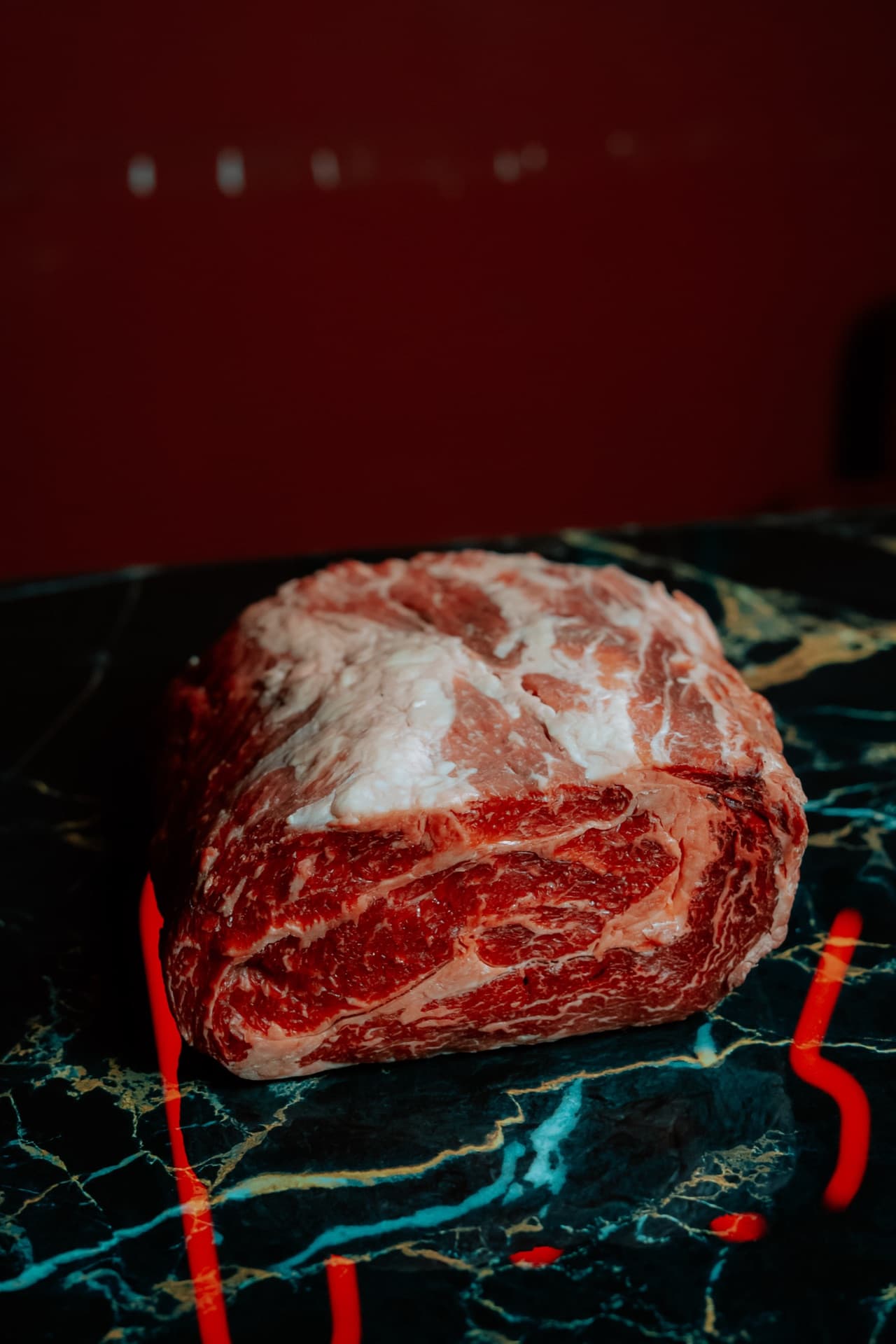
The dark, savoury crust on a well-cooked steak comes from the Maillard reaction: the amino acids and sugars in the meat, heated to a high temperature, react with each other and produce the brown colour and the roast smell. To get it right you need strong heat and a dry surface. A wet or lukewarm piece of meat stews instead of searing, and the crust never arrives.
What the Maillard reaction is
A French name from 1912
The name is that of the French chemist Louis-Camille Maillard, who described it in 1912 while studying how amino acids, the building blocks of proteins, bind with sugars. He was not working on cooking at the time: the fact that the same reaction browns bread and meat was recognised later. It is reconstructed, among others, by Gambero Rosso and by the American Chemical Society's magazine, Chemical & Engineering News.
It is not one reaction
We say "reaction" in the singular, but chemists point out that it is a network of steps. First amino acids and reducing sugars combine, then the products turn into molecules that carry colour, aroma and flavour. For a cook the result is always the same: the colour changes, and with the colour the taste changes.
Maillard or caramelisation?
The two are often confused. Caramelisation involves only sugars, and needs higher temperatures to start. The Maillard reaction also needs amino acids, which is why it is the main player in anything that contains protein: meat, bread, roasted coffee. On a steak, the crust that forms is Maillard.
What you need to do it well
Strong heat
The sources do not give a single number. Gambero Rosso says the reaction starts at around 140 degrees, and another Italian source we read gives a range between 140 and 180 °C. The point to remember is that it takes temperatures well above the 100 °C of water. That is why meat cooked in a covered pan, or boiled, stays grey: as long as there is liquid to evaporate, the surface cannot climb past 100 °C.
A dry surface
Moisture slows the reaction, while high heat and low moisture favour it. In practice: before cooking, pat the meat dry with a cloth, and take off the heat what is already dark. A wet surface first has to evaporate its water, and in the meantime the meat cooks inside without browning outside.
The right amount of time
The reaction has a limit. Past the right point the crust turns burnt and bitter, and Gambero Rosso notes that pushing it too far can form acrylamide, an unwanted substance. With meat the practical problem is a different one: a piece left too long on the fire dries out before it even burns. So you look for a quick crust, which means very hot fire for a short time.
Why extreme heat helps
On a thick cut the risk is cooking the centre before you have a crust. A very strong heat source solves the problem: the surface browns in moments and the inside stays pink. That is why for important cuts, such as fillet or ribeye, a fierce, short cook is preferred to a long, gentle one. The difference between the degrees of doneness, from rare to well done, is explained in the article on steak doneness (in Italian).
The same reasoning applies to a bone-in cut. The Florentine steak, for example, comes from a very hot grill, and we write about it in the article on bistecca alla fiorentina (in Italian).
How to recognise a good crust
The right colour is a deep brown, from hazelnut to mahogany, even over the whole surface. If you see black or charred patches, the reaction has gone too far and the taste turns bitter; if the meat is only greyish, it never started. The smell says something too: a well-made crust smells of roast, not of acrid smoke. On the plate you feel it when you cut, because the surface offers a little resistance and the inside is soft. You do not need to measure anything: eyes, nose and a few cooks of experience are enough.
How to do it at home
1. Take the meat out of the fridge a little earlier, so it is not ice cold in the middle.
2. Dry it well with kitchen paper.
3. Heat the pan or grill until it is very hot before putting the piece down.
4. Do not move the meat while the crust forms: if you keep shifting it, it will not brown.
5. Turn the piece once or twice, then let it rest before cutting.
One tip on salt: if you add it long before cooking, the water that comes out of the meat can wet the surface. Adding it just before or just after cooking avoids the problem.
The crust at Carpaccio Beef Restaurant
With us the meat cooks on ceramic slabs that reach 900 °C: the crust forms in moments and the piece stays tender inside. We recommend rare or medium, because beyond medium the meat dries out. The grill works with Black Angus and Wagyu selections, bone-in or boneless, and the full list of dishes is on the menu.
Book at Carpaccio Beef Restaurant
We are at Via Marche 9, on the corner of Via Sicilia, a short walk from Via Veneto. Book with the "Prenota" button on the website, on TheFork or at +39 06 86218298.