
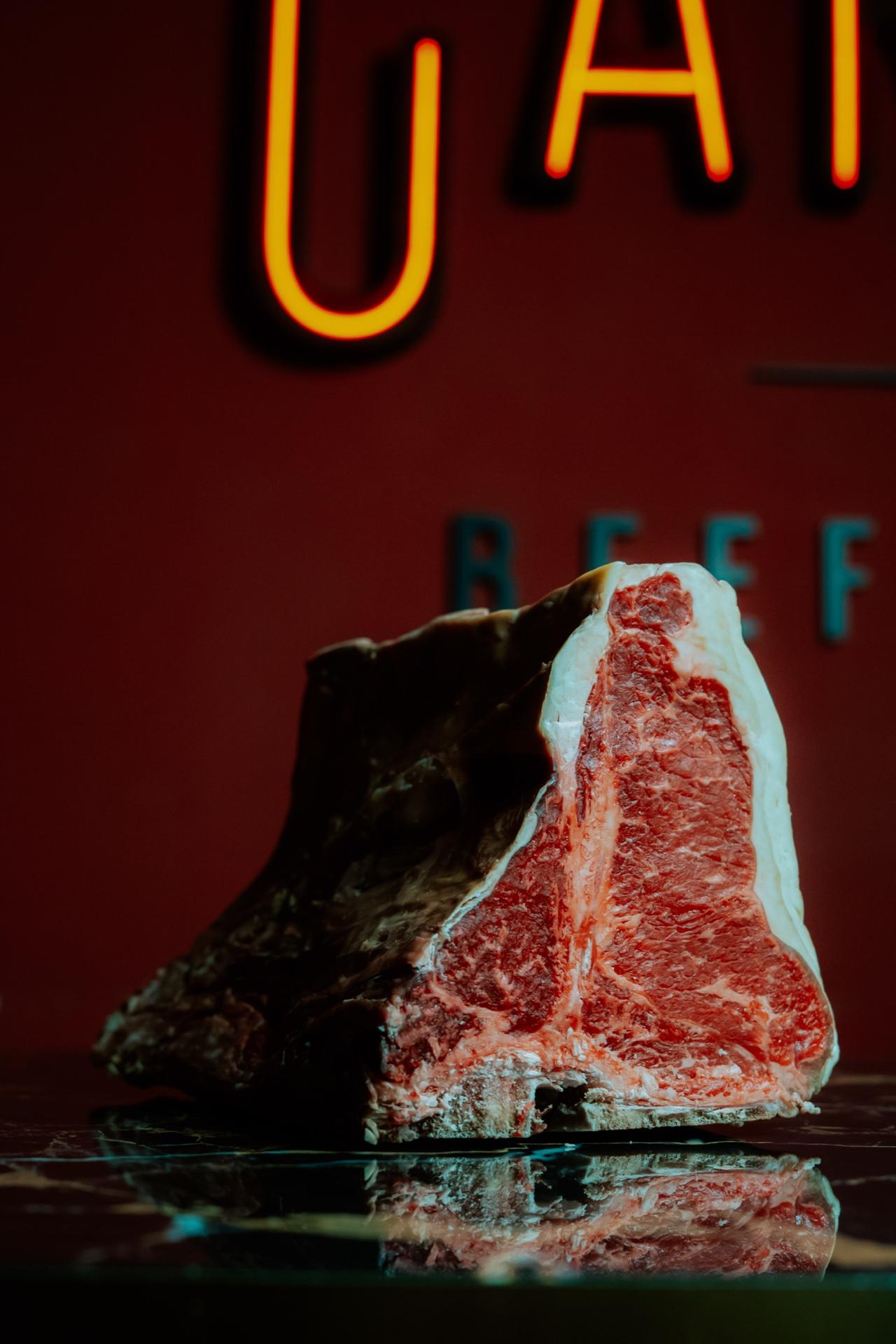
Bistecca alla fiorentina is a loin cut of beef with a T-shaped bone, cooked over embers and served rare. On one side of the bone is the fillet, on the other the strip loin. It is traditionally made from vitellone or scottona, it is thick and weighs between one and one and a half kilos, and it is salted only after cooking.
The cut
The fiorentina comes from the lumbar part, the back near the tail of the animal. The cut includes the T-bone, and on its two sides two different muscles: the fillet, tender and lean, and the strip loin, more flavourful with a little fat. In a single piece you taste two meats.
It is a cut bought whole and shared at the table. Its size says as much: the weight is normally from one to one and a half kilos, so a fiorentina is meant for several people. The thickness, according to the sources, runs from about 3 to 5 centimetres. For a bone-in cut of that height, thickness is the reason the cooking is so particular.
Vitellone, scottona and Chianina
The words used to describe the animal have a precise meaning. Tradition says the fiorentina is made from vitellone or scottona, and originally from Chianina, the white breed of the Val di Chiana. We explained these words in another article, on the differences between vitellone and scottona: it is worth rereading if you want to understand what you read on a menu when the name of an animal or a breed appears.
How it is cooked
The fiorentina is cooked over a wood fire, a strong one. Tradition mentions woods such as oak, holm oak and olive. The method has two stages. First the cut is exposed to intense heat, which builds the crust. Then it is moved to a cooler zone, where the heat reaches the centre more slowly.
The steak is turned only once. The time depends on thickness. One particular thing is the position: the steak is stood up on its bone, because the bone conducts heat towards the heart of the cut. To move it, cooks use tongs, not a fork: a fork pierces the meat, though the reason is mostly one of presentation.
The result sought is a red, tender centre, around 50-52 °C at the core, in other words rare. If you want to understand what these words mean and how to ask for a different doneness, you will find it all in the article on steak doneness.
Salt, afterwards
The best-known rule of the fiorentina concerns salt. Before cooking, you do not salt and you do not oil. Afterwards, you add coarse or flaked salt and a drizzle of extra virgin olive oil.
The reason is the one that holds for all cooking over embers: water on the surface slows the crust, and salt draws it out. Adding it at the end keeps the crust and gives a contrast of flavour on the sliced cut. Those who follow tradition also do it for a simpler reason: with good meat, the flavour is already there and there is nothing to hide.
Where the name and the tradition come from
As with many famous dishes, the origin of the fiorentina is told through a legend. The most widespread ties it to the feast of San Lorenzo, on 10 August, and to the age of the Medici. According to the story, English visitors said "beef steak" in front of the meat cooking over the embers, and from that name came "bistecca".
There is a more recent and less romantic version, which credits the word to the English who lived in Florence in the nineteenth century. There is no firm proof for either, and it is worth knowing that on this subject the sources disagree. What remains is the word: bistecca, from the English beef steak, entered Italian by way of Florence.
Fiorentina or costata?
They are often confused. The costata is a bone-in cut, but it does not have the T shape: it has a bone on one side only and one main muscle. The fiorentina is a T-shaped cut, with fillet and strip loin on the two sides of the bone.
For the person ordering, the practical difference lies in the character of the meat. The fiorentina has two textures in the same cut, and that changes the way it is shared and eaten. When you find one of the two names on a menu, ask the dining room whether the cut includes the fillet or not, and what weight it is.
How it is eaten
The fiorentina is meant to be shared among several people, and it is worth tasting the fillet and the strip loin one after the other, to feel the difference.
For anyone who has never ordered a cut this large, the rule is to start from the number of diners and the weight. You can look at the menu before you come and see how portion sizes are indicated.
What to ask before ordering
When a cut this large appears on a menu, four questions avoid surprises. How much it weighs and how thick it is. Whether the cut includes both fillet and strip loin. How it is normally served and whether a different doneness can be requested. And how many people it is meant for. They are simple questions, and people in the dining room are glad to answer, because a cut chosen knowingly is better eaten.
Book at Carpaccio Beef Restaurant
We are at Via Marche 9, on the corner of Via Sicilia, a short walk from Via Veneto. Book with the "Prenota" button on the website, on TheFork, or by phone at +39 06 86218298.