
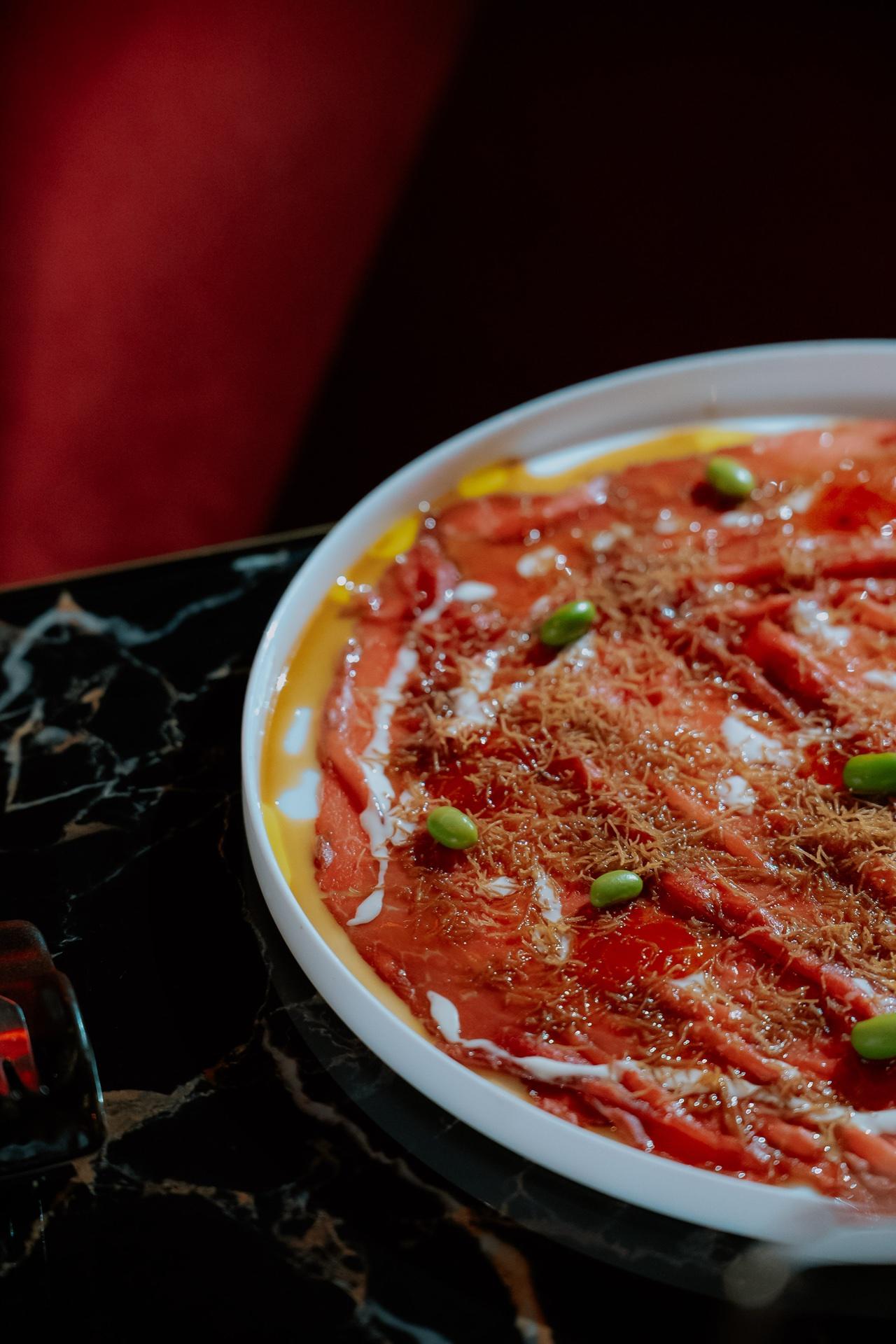
Vitello tonnato is veal poached whole, cooled, sliced thin and covered with a sauce of tuna, anchovies, capers, oil and lemon. It is served cold, which is why it comes back to the table every summer. Pellegrino Artusi gave it number 363 in his cookbook, and his sauce has no eggs and no mayonnaise. At Carpaccio Beef Restaurant, at Via Marche 9, the tonnato sauce goes on a different meat: the raw beef of our Dolce Vita carpaccio.
What vitello tonnato is
The dish has two parts, made separately. First the meat: a lean cut of veal, cooked whole and left to cool. Then the sauce, which gives the dish its name and which every family makes its own way. The two meet at the end, when the slices are laid on the plate and covered.
Today it is mostly associated with Piedmont, where it is called vitel tonnè, and it appears as a starter on menus all over Italy. The written recipe people quote most, though, comes from a man born in Romagna who lived in Florence.
Artusi's recipe 363
La scienza in cucina e l'arte di mangiar bene ("Science in the Kitchen and the Art of Eating Well") is the cookbook Artusi published at the end of the nineteenth century. Vitello tonnato sits in the rifreddi section, the dishes served cold, as number 363. Like most of his recipes, it is short and exact.
The meat and the cooking
Artusi starts with a kilo of milk-fed veal from the leg or rump, boneless, trimmed of membrane and fat. Before cooking he studs it with two anchovies: he opens them, removes the bone, cuts them into eight pieces and pushes the pieces into the meat. Then he ties it and boils it for an hour and a half in salted water with a quarter of an onion stuck with cloves, a bay leaf, celery, carrot and parsley.
When the meat is cold he cuts it into thin slices and leaves them to sit "for a day or two" in a narrow jar, covered with the sauce. The cooking broth is not thrown away: Artusi suggests using it for a risotto.
The sauce, with no eggs
The sauce starts with 100 grams of tuna in oil and two anchovies, pounded and pushed through a sieve. Fine oil goes in "generously", a little at a time, with the juice of one lemon or more, until the sauce stays liquid. The capers go in last, squeezed free of their vinegar. The dish is served with its sauce and lemon wedges.
Many modern recipes build the sauce on mayonnaise or thicken it with hard-boiled yolks. Artusi uses no eggs. The creaminess comes from the sieved tuna and the oil.
Why it is a summer dish
In his "Note di pranzi", the sample menus for each month of the year, Artusi puts vitello tonnato in July, as the cold course of the month's second lunch. It is cooked the day before, rests in its sauce, and does not ask anyone to light a stove at lunchtime.
That is still why it works. You make it ahead, serve it cold, and the acidity of lemon and capers clears the mouth even when it is hot outside.
Dolce Vita: tonnato sauce on raw beef
Dolce Vita is one of the carpaccios on our menu. The slice of raw beef carries three things: tonnato sauce, fried capers and fermented lemon. In our piece on the house variations we called it vitello tonnato read backwards, and the description holds up after rereading Artusi.
The elements are the same as in recipe 363, moved one step over. The lemon that Artusi squeezes into the sauce and serves in wedges is fermented here. The capers, which arrive squeezed from their vinegar in the cookbook, are fried in our kitchen and add a crisp note the raw meat does not have. The biggest change is the meat. In place of poached veal there is thinly sliced raw beef, dressed at the moment of serving and never before, so the acidity does not "cook" the slice. The reason is in our article on the history of carpaccio.
The name is the same as Federico Fellini's film La dolce vita, which tied Via Veneto to an era. At the top of the street, at Porta Pinciana, there is a Largo Federico Fellini; from there to us, at the corner of Via Marche and Via Sicilia, it is a few minutes on foot.
How to order it
Dolce Vita is among the lighter carpaccios on the menu, so it suits the start of dinner or a single course at lunch. For two, pair it with a carpaccio of a different character: the Cipriani, with burrata cream, Parmesan and lemon dressing, or the Romano, with artichokes and crisp guanciale (cured pork cheek). If you prefer raw meat cut into small cubes, the tartares are on the same page of the menu, and our article on tartare explains how the two ways of handling raw meat differ.
What to drink with vitello tonnato
Tuna, anchovies and capers make the sauce salty, and the lemon makes it sharp. A tannic red fights with it. A dry white with good acidity or a classic-method sparkling wine works better, the same pairings we suggest for carpaccios and tartares. The bubbles and the acidity clean the mouth between bites without covering the meat. If you want a recommendation on the label, ask in the dining room when you order.
Book at Carpaccio Beef Restaurant
We are at Via Marche 9, on the corner of Via Sicilia, a short walk from Via Veneto. Lunch is Monday to Friday, 12:30 pm to 3:00 pm; dinner is every day, 7:00 pm to 10:30 pm, until 11:00 pm on Friday and Saturday. Book with the "Prenota" button on the website, on TheFork, or by phone at +39 06 86218298.