
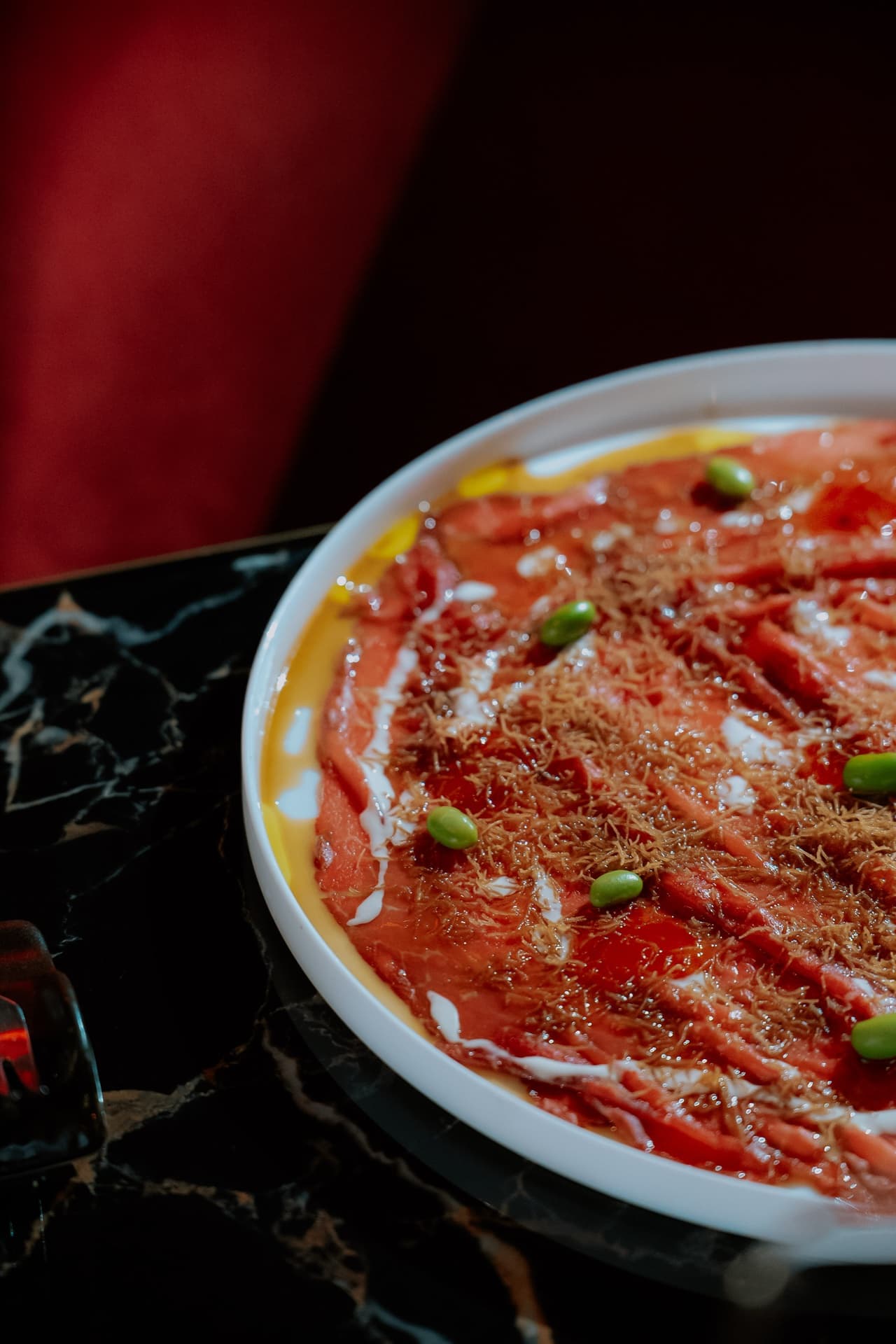
You have seen the word on an Italian menu and you are not entirely sure what arrives: carpaccio is raw beef, sliced paper-thin and dressed cold. It was invented in 1950 at Harry's Bar in Venice by Giuseppe Cipriani, and it is far younger than most of the Italian dishes around it. Here is where it comes from, how to recognise a good one, how it differs from tartare and bresaola — and what you will find on the menu of a Roman restaurant named after it.
The origin of carpaccio: Harry's Bar, Venice, 1950
Carpaccio is younger than almost everyone assumes. It is not a medieval Venetian recipe or a peasant tradition rescued from obscurity: it has a date, an address, and a customer with a name.
Giuseppe Cipriani and countess Amalia Nani Mocenigo
In 1950, at Harry's Bar in Venice, a regular guest — countess Amalia Nani Mocenigo — had been told by her doctor to avoid cooked meat. Giuseppe Cipriani, who ran the bar, built her a new dish instead of a compromise: lean beef sliced almost translucent, laid flat on a cold plate, finished with a pale sauce drawn over it in thin lines.
The constraint explains the dish. Without heat there is nothing to hide behind — no crust, no reduction, no smoke — so the quality of the raw material is not one element of the recipe, it is the recipe. Which is why carpaccio travelled: any kitchen can attempt it, and few do it well.
Why the dish is named after a painter
Vittore Carpaccio was a Venetian painter working around the turn of the sixteenth century, and in 1950 a large exhibition of his work was drawing crowds to Venice. Cipriani looked at the plate he had just made and saw the same palette: deep reds broken by whites and creams. He gave the dish the painter's name.
It stuck so well that it stopped being a proper noun. In Italian and in English, carpaccio now describes a technique — any ingredient sliced paper-thin and served raw, from sea bass to artichoke. Worth knowing when you read a menu: the original, and the default when nothing else is specified, is beef.
What is actually on the plate
Strip away the story and carpaccio comes down to three decisions: which cut of beef, how thin it is sliced, what goes on top. Everything that can go wrong goes wrong in one of those three.
The cut, the knife and the original dressing
The beef has to be lean and fine-grained — fillet or a comparably tender cut. Sinew that long cooking would soften stays stubborn when raw. The meat is brought down to a firm, very cold temperature before slicing: the only way a blade takes slices that thin without tearing them. Plated well, they overlap barely and cover the whole surface.
The original dressing is a mayonnaise loosened with lemon juice and sharpened with a little mustard and Worcestershire sauce, and it goes on at the moment of service — never in advance. Acid left in contact with raw beef starts to denature the proteins: the meat pales, firms up, and stops being carpaccio.
Carpaccio, tartare and bresaola: three different things
Tartare is raw beef too, but chopped or minced and mixed with its seasonings before it reaches the plate, where it arrives as a mound rather than a sheet. The difference is not presentation, it is how you taste it: in a carpaccio the beef and the dressing stay distinct on the tongue, in a tartare they arrive already married.
Bresaola is a third thing again: beef salted, air-dried and matured for weeks. Preserved rather than fresh, firmer, saltier, with a concentrated flavour raw beef does not have — yet sliced as thin as carpaccio and served the same way, which is why the two get confused. We have leaned into that: the Bresaola sits among our ten carpacci, our own, with Parmigiano shavings and rocket.
How to tell a good carpaccio, and how to eat it
A carpaccio is easy to judge and hard to fake, which makes it a useful thing to order the first time you sit down somewhere new.
What to look for before the first bite
Colour first: a clear, bright red, even across the plate, no brown or grey edges, glossy rather than wet — a puddle of liquid means it was sliced too far ahead of service. Then restraint: the dressing is there to lift the beef, and if you cannot see the meat underneath it, the kitchen is covering something.
On safety, the standard to expect is unglamorous and non-negotiable: whole cuts from traceable suppliers, an unbroken cold chain, slicing to order, and an HACCP plan behind all of it — the food-safety framework every restaurant kitchen in Italy works to. If you want to ask, ask: a kitchen proud of its sourcing enjoys the question.
Temperature, timing and how to hold the fork
Carpaccio is served cold but not frozen, ideally on a chilled plate, and it does not improve while it waits. As it warms towards room temperature the fats soften, the slices go slack and the dressing separates: the first minutes after it lands are the best ones.
And it is not a steak, so do not attack it with the knife. Gather or fold a slice onto the fork with a little dressing and one of the garnishes, and take it in a single bite. It belongs at the start of the meal, before anything off the grill.
What to drink with it
Raw lean beef and a bright dressing want a white with acidity and some body: a Vermentino, a Verdicchio, a Soave Classico. Sparkling works just as well, and a dry, mineral bubble does a good job of clearing the palate between bites.
Heavily tannic reds are the one thing to avoid — tannin against raw lean beef reads metallic. If you want red, ask for something light and fresh, served slightly cool. The simplest route is to say what you are eating and let the floor staff pick the glass from our cellar.
Ordering carpaccio in Rome
We took the name of the dish for the restaurant, which sets a fairly public standard to meet. Carpaccio here is not one item on the menu but a whole section of it: ten signature versions, one principle, ten directions.
Ten signature carpacci — and where to start
Start with the Cipriani, our tribute to the Venetian original: burrata cream, shoots, Parmigiano shavings, lemon dressing, red beet powder. It is a nod rather than a replica — the creaminess comes from the burrata instead of the mayonnaise, and the lemon does the work it did in 1950.
From there they move outward. The Romano goes local, with artichokes and crispy guanciale; the Truffle keeps it short, black truffle shavings and crisp bread in hazelnut butter; the Trevigiano brings radicchio, asparagus, hazelnuts, gorgonzola and honey; the Dolce Vita has tuna sauce, fried capers and fermented lemon; the Cacciatora is the most rustic, with balsamic vinegar, olives, capers and sun-dried tomatoes. Three go further afield or break the rule on purpose: the Zen with ponzu, ginger mayo, edamame and kataifi pastry, the Kaffir with kaffir lime leaves, coriander, turmeric and lemongrass, and the Roastbeef di Carpaccio, lightly seared in its own brown jus. With the Bresaola, that makes ten.
Practical notes for a first visit
We are at Via Marche 9, on the corner of Via Sicilia, a few minutes on foot from Via Veneto. Expect around 50 euro per person. We are open every day, with lunch on weekdays and dinner every evening — on Saturday and Sunday we serve dinner only. There is on-street parking nearby, and the staff speak English.
You can book through the widget on this site, on TheFork, by phone on +39 06 86218298. And if beef is what brought you, the sensible order is carpaccio first and the grill after: our selection runs on Wagyu and Black Angus, bone-in and boneless, cooked over ceramic plates that reach very high temperatures.