
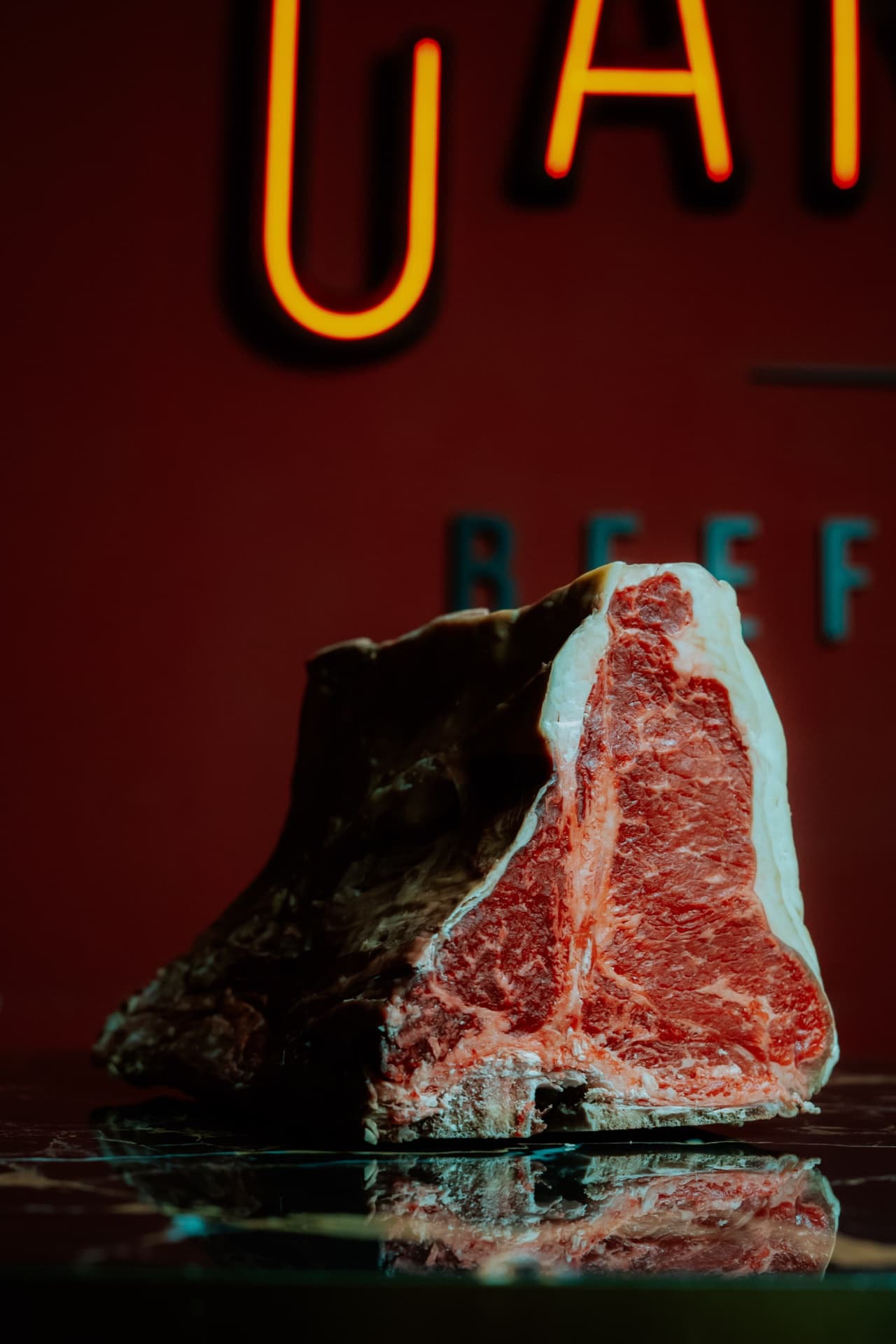
You have three or four nights in Rome, and at some point you want beef — a proper cut, cooked properly, without ending up in a place that serves the same laminated menu as the one next door. The good news is that Rome takes meat seriously. The less obvious news is that a Roman steakhouse does not work like an American one: the cuts are named differently, the beef is priced differently, dinner starts later, and the kitchen almost certainly also makes carbonara. This guide explains how the whole thing works, so you can order well anywhere in the city — and, at the end, where to find us, at Via Marche 9, a few steps from Via Veneto.
A steak restaurant in Rome is not an American steakhouse
The word steakhouse travels, but the format does not travel unchanged. In Rome the closest local category is the braceria — a restaurant built around a live fire — and its habits differ from the American model in ways that catch visitors out on the first evening. Nothing here is worse or better. It is simply a different set of rules, and knowing them turns a confusing menu into an easy one.
Cuts are sold by weight, and often shared
In an American steakhouse each person orders a steak, and the menu tells you it weighs twelve or sixteen ounces. In Rome the large cuts — the bone-in ones especially — are usually listed with a price per kilo, and the actual piece is chosen from the ageing fridge or brought to the table before cooking so you can agree on the size. Your bill therefore depends on the weight of the specific piece, not on a fixed line price. It is normal to ask for a smaller or larger one.
That also means the big cuts are often ordered for two people rather than one. A Tomahawk or a T-bone lands on a board in the middle of the table and gets divided, with sides ordered separately — vegetables, potatoes, salad. If you want a plate that is yours alone, ask for a boneless cut: a fillet, a ribeye or a sirloin steak is served as an individual portion.
The grill, and what an Italian kitchen does around it
Italian grilling is deliberately plain. A good cut arrives with salt, sometimes a little oil, and nothing else, because the point is the beef and the crust the fire gives it. Sauces exist but they are a side order, not a default: if you want one, you ask for it. Do not expect the heavy butter-and-blue-cheese repertoire — and do not expect a waiter to be surprised if you skip sauce altogether, which is what most Italians do.
Equipment varies more than the menus admit. Some kitchens use wood or charcoal, some use ceramic plates that reach far higher temperatures than a domestic grill ever could — ours run up to 900 °C, which is what produces a dark crust in seconds while the inside stays rare. Ask how the meat is cooked if you are curious; a restaurant that has invested in its fire is usually pleased to tell you.
How dinner works in Italy: times, booking and pace
More visitors are tripped up by the clock than by the menu. Italian service hours are narrower than in most of northern Europe or the United States, and a restaurant that looks empty at seven can be completely full by nine.
When Romans actually sit down to eat
Lunch in Rome runs roughly from half past twelve to three, and it is a real meal, not a sandwich. Dinner service typically opens at seven and the room fills between half past eight and half past nine. If you arrive at seven you will often have the dining room to yourself and the full attention of the kitchen, which is not a bad trade at all — and it is the easiest slot to get on a Friday or Saturday.
Kitchens also close earlier than visitors expect. Ours takes its last dinner tables at 22:30 from Sunday to Thursday and at 23:00 on Friday and Saturday, and we serve lunch Monday to Friday from 12:30 to 15:00 — Saturday and Sunday are dinner only. Those weekend lunch closures are common across the city, so if you are planning a long Saturday lunch, check first rather than turning up.
Booking: how far ahead, and through which channel
Book. Rome is busy year round and the good rooms are small; walking in at nine on a Saturday and expecting a table is optimistic. Two or three days ahead is usually enough for a weekday, a week for a weekend or for a table of six or more. If your plans are loose, book anyway and change the time later — every channel below lets you.
There are three ways to reserve with us, and all of them reach the same book: the booking form on our own site, which opens a TheFork widget in a window; TheFork itself; and the telephone, on +39 06 86218298 — the quickest option if you are calling from abroad or want to ask something while you book. If you need a room to yourselves, we have a private dining room on the ground floor seating fifteen, and that one is worth asking about early.
What a fair price looks like
Beef is the most expensive thing on an Italian menu, and prices in central Rome carry a location premium. Still, the range of what is reasonable is fairly narrow, and the main way people overspend is by not understanding how the meat is priced rather than by choosing an expensive restaurant.
Reading a menu that prices beef by the kilo
When the grill section shows a price per kilo, do the arithmetic before you order. A bone-in cut for two is rarely under a kilo once the bone is counted, so a figure that looks moderate per kilo becomes the largest line on the bill. Japanese Wagyu, where it is offered, sits in a different bracket again — it is a treat to share in a small portion, not the default order. If in doubt, say the weight you want rather than the cut alone.
Everything around the beef is where an evening stays affordable. A plate of carpaccio at our tables runs from €18 to €24 depending on the version, a pasta sits at the price of a normal Roman trattoria plate, and sides are ordered à la carte. Across a full dinner our average is around €50 per person, wine excluded — a useful benchmark for central Rome generally, not just for us.
Coperto, water and service
Two small conventions surprise almost every visitor. The coperto is a fixed per-person cover charge, listed on the menu, that covers bread and the table setting; it is legal, normal and not a scam. Water is ordered and paid for, still or sparkling, by the bottle. Tipping is not obligatory in Italy and service is not automatically added for small tables — rounding up, or leaving five to ten per cent when you have been looked after well, is generous and entirely sufficient.
What to order, in the right order
An Italian meal is built in courses, and a steak dinner is no exception: something raw or light to start, a pasta if you want one, then the grill. You are not obliged to take every course — nobody will mind if you go straight to the beef — but the sequence is what the kitchen is designed around, and following it is the best way to eat well.
Start raw: carpaccio and tartare
Raw beef is the most Italian way to begin a meat dinner, and it tells you more about the quality of the sourcing than anything cooked: there is nowhere to hide. Carpaccio is beef sliced almost transparently thin and dressed; tartare is hand-cut and seasoned. Both are ordinary starters here, both are safe in a serious restaurant, and both are lighter than they sound.
Carpaccio is our signature — it is, after all, our name — and we serve ten variations of it. The Cipriani is the tribute to the Venetian original, with burrata cream, Parmigiano shavings and a lemon dressing. The Truffle adds black truffle shavings and crisp bread with hazelnut butter. Others take the dish somewhere else entirely: the Romano with artichokes and crisp guanciale, the Zen with ponzu and edamame, the Kaffir with lime leaf, coriander and ginger. If you want to understand the kitchen in one plate, start with one of these.
The grill: choosing a cut
Match the cut to the appetite rather than the price. The fillet is the tenderest and the leanest, which makes it the right answer for one person who wants a clean, elegant plate. The ribeye and the sirloin steak carry more fat through the muscle and therefore more flavour, and they hold up better to a hard sear. Bone-in — T-bone, rib on the bone, Tomahawk — is the most spectacular and the most generous, and it is meant for two.
On sourcing, the useful question is not the brand of the fridge but the origin of the animal. We work with two selections that sit at opposite ends of the register: Black Angus, dependable and deeply beefy, and Wagyu, marbled to the point that a small portion is enough. Ask for rare or medium rare on anything from the grill; well done on a good cut flattens the differences you are paying for.
Do not skip the Roman classics
A steakhouse in Rome that cannot make carbonara is not really a Roman restaurant. Ours is on the menu next to the amatriciana and the tagliolini with truffle, and a shared plate of pasta between the raw course and the grill is exactly how a local would build the evening. It is also the cheapest way to make a meat dinner feel like a Roman one.
Where Via Veneto fits in — and where we are
Via Veneto is the sweeping, tree-lined street of Rome's Dolce Vita years, and the quiet grid of streets behind it is one of the most pleasant places in the city to eat at night: elegant, residential, well lit, and free of the queues that form around the main monuments. It suits a dinner you have planned rather than one you stumble into — which is exactly what a good cut of beef deserves.
Carpaccio Beef Restaurant is at Via Marche 9, on the corner of Via Sicilia, a few steps from Via Veneto. The restaurant itself is recent, but the family behind it is not: the Bertollini family has worked with meat since 1893, when the first butcher's shop opened — that date belongs to the family's trade, not to this dining room. There is on-street parking nearby, the staff speaks English, and the menu is written in Italian and English. Book through the site, on TheFork or by phone on +39 06 86218298 — and whether you come to us or eat somewhere else entirely, order the raw beef first.